
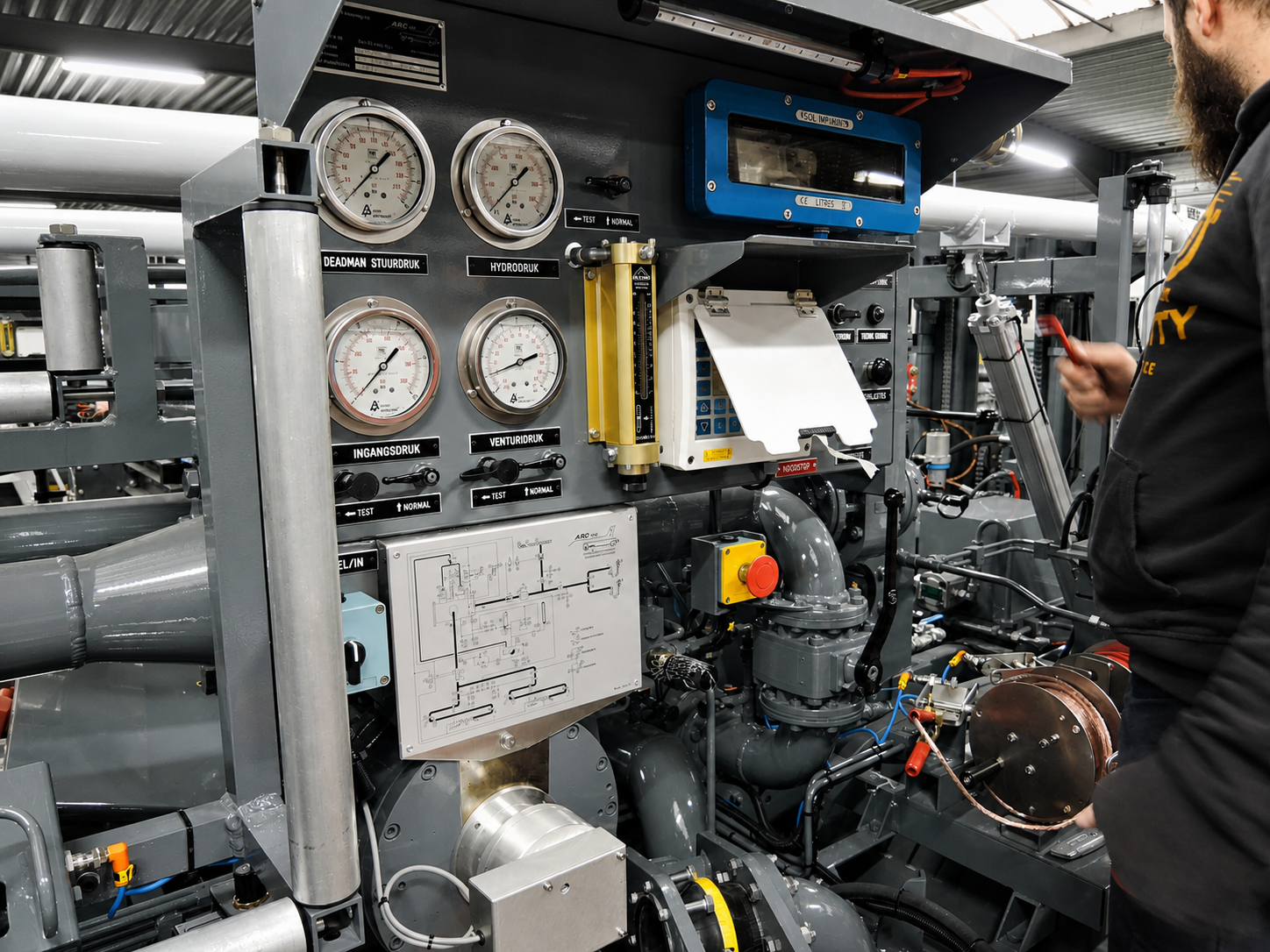

Unreadable Differential Pressure Gauge on Into-Plane Fuelling Equipment: What Should You Do?
An unreadable differential pressure gauge on an aircraft refueller or hydrant dispenser is an equipment serviceability defect. It prevents the operator from reliably completing the required monitoring of filter differential pressure during fuelling.
In a recent ARC LinkedIn quiz, we asked a practical question for aviation fuelling operators, supervisors, maintenance personnel, and fleet managers:
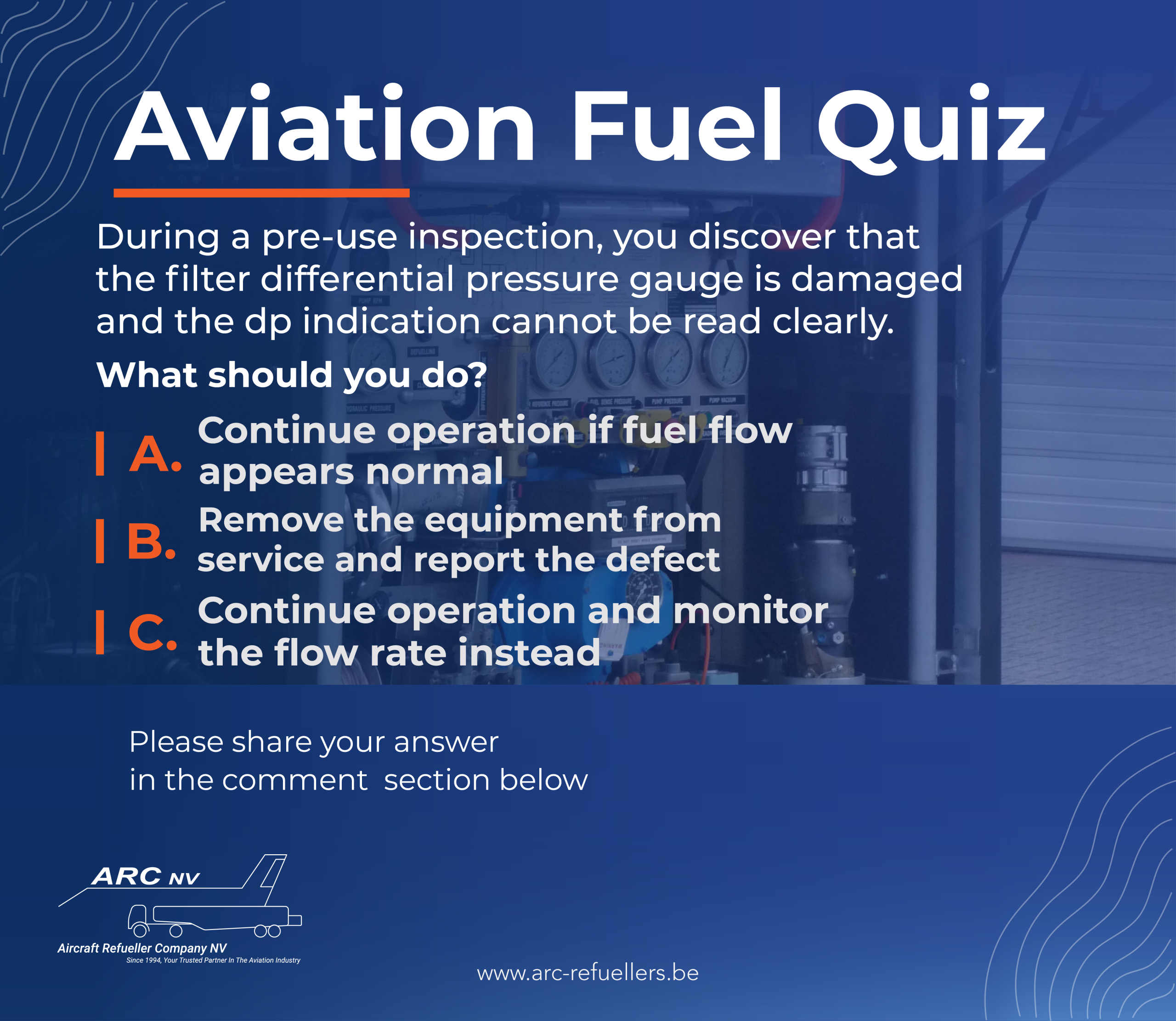
During a pre-use inspection, you discover that the filter differential pressure gauge is damaged and the dP indication cannot be read clearly. What should you do?
A.Continue operation if fuel flow appears normal
B. Remove the equipment from service and report the defect
C. Continue operation and monitor the flow rate instead
The correct answer is:
B — Remove the Equipment From Service and Report the Defect
In the quiz scenario, the correct immediate action is to remove the equipment from service and report the defect.
The principles discussed in this article apply to aircraft refuellers and hydrant dispensers fitted with filter vessels requiring differential-pressure monitoring. These are referred to collectively throughout the article as into-plane fuelling equipment or fuelling equipment.
Specific equipment configurations, filtration technologies, and monitoring arrangements may differ. The applicable operating procedure, approved equipment design, customer requirements, and OEM instructions must therefore always be followed.
At the point of discovery, the operator should not assume that another display, instrument, or protective device provides an acceptable substitute. Any decision to return the equipment to service based on an approved independent electronic dP monitoring system must follow a documented technical assessment confirming that the required indication, recording and protective functions remain fully available.
Until that assessment has been completed, the equipment should not be released for pressure fuelling.
An unreadable differential pressure gauge is an equipment serviceability defect. It prevents the operator from reliably completing the required monitoring of filter differential pressure during fuelling.
The gauge or monitoring system should therefore be assessed, repaired or replaced as necessary, and functionally verified before the equipment returns to service. The defect, corrective action and verification result should be recorded in the equipment records.
Why an Unreadable Differential Pressure Gauge Matters
Differential pressure, commonly abbreviated as dP, is the difference between the inlet and outlet pressures of a filter vessel while fuel is flowing.
It represents the resistance created as fuel passes through the vessel and its installed filter elements.
Every filtration system has an inherent starting resistance. The dP may then change according to several factors, including:
- the filtration technology and vessel configuration;
- the type, number, and condition of the filter elements;
- the rate at which fuel is flowing;
- particulate retained within the elements;
- water loading, where relevant to the filtration technology;
- element installation and sealing condition;
- damage, bypass, or another abnormal internal condition.
The dP indication therefore provides the operator and maintenance team with important information about how the filtration system is behaving under flow.
It does not directly prove that the fuel is clean, and it does not replace fuel sampling, visual appearance checks, or other required fuel-quality controls. However, it is an essential part of monitoring filter performance.
ARC explains the wider role of filtration in maintaining clean, dry aviation fuel in its article on aviation fuel filtration.
If the dP indication is unavailable or unreliable, the required monitoring of filter performance cannot be completed properly.
What Differential Pressure Can Tell the Operator
A gradual rise in dP may be expected as filter elements retain particulate matter or, depending on the filtration technology, accumulate water or other contaminants.
However, dP does not always increase gradually.
A sudden rise may indicate an abnormal restriction, rapid contamination loading, or another condition requiring investigation.
A sudden reduction can also be significant. It may indicate element bypass, a damaged element, seal failure, incorrect installation, or another loss of filtration-system integrity.
For this reason, a low dP reading is not automatically a good reading.
The operator must be able to:
- observe the actual dP;
- confirm that it remains below the applicable maximum;
- compare it with previous readings taken at a similar flow rate;
- identify an unexplained positive or negative change;
- report and respond to an abnormal indication.
An unreadable differential pressure gauge prevents these checks from being completed reliably.
Differential Pressure Depends on Flow Rate
Differential pressure and flow rate are related, but they are not interchangeable.
As fuel flow through the filter increases, dP normally increases because the filtration system creates greater resistance to the passage of fuel. When the flow rate decreases, the dP normally decreases.
This relationship is important when comparing readings.
A dP value recorded at 800 L/min cannot be directly compared with one recorded at 2,000 L/min without accounting for the difference in flow rate.
Meaningful comparisons should therefore be made at the same or a sufficiently similar flow rate.
This is also why option C in the quiz is incorrect.
Monitoring flow rate alone does not tell the operator the pressure difference across the filter vessel. Fuelling equipment may continue delivering fuel at an apparently normal flow while the dP is excessive, unexpectedly low, or otherwise abnormal.
The two measurements provide different information:
- Flow rate shows how much fuel is being delivered over time.
- Differential pressure shows the resistance across the filter vessel at that flow rate.
Flow rate does not replace dP indication.
Why “Fuel Flow Appears Normal” Is Not Sufficient
Option A suggests continuing operation because the fuel flow appears normal.
That is not an acceptable basis for releasing the equipment.
A functioning pump, moving meter, and stable delivery rate do not confirm that the filter vessel is operating within its permitted dP range.
They also do not confirm that:
- the dP gauge piston is moving freely;
- the gauge returns correctly to zero;
- the sensing lines are unobstructed;
- the indication responds without delay;
- the displayed value is accurate and reliable;
- an associated dP limiting device will operate correctly;
- the filter elements are correctly installed and not bypassing;
- the filtration system has not experienced an abnormal change.
Aviation fuelling controls are not interchangeable. The availability of one instrument or protective function does not automatically compensate for another required function that is unavailable.
If the operator is required to observe dP during pressure fuelling, the fact that fuel continues to flow does not remove that requirement.
The relationship between instrumentation, operational data, and controlled fuel delivery is discussed further in ARC’s article on fuel metering and monitoring systems.
Direct-Reading Gauges and Electronic dP Monitoring
Into-plane fuelling equipment may use different methods of measuring differential pressure.
A traditional arrangement uses a permanently installed direct-reading piston gauge connected to pressure-sensing points on the upstream and downstream sides of the filter vessel.
Other systems use electronic pressure transducers connected to an electronic monitoring system or programmable logic controller. These arrangements may provide continuous dP indication, electronic recording, and, where designed and approved for the purpose, real-time dP correction or automatic interruption of fuel flow.
The key operational requirement is that the installed system must provide a valid, reliable, and observable indication.
Where an electronic dP monitoring device is used instead of a piston-type gauge, its signal must be properly monitored, recorded, and maintained in accordance with the approved design, operating procedure, and manufacturer’s instructions.
Where both mechanical and electronic systems are installed, the effect of damage to one device must be assessed against the approved configuration.
The operator should not assume that another display provides an acceptable substitute unless that arrangement has been technically confirmed and authorised.
An informal workaround must not be created around damaged instrumentation.
What the Operator Must Be Able to Do During Fuelling
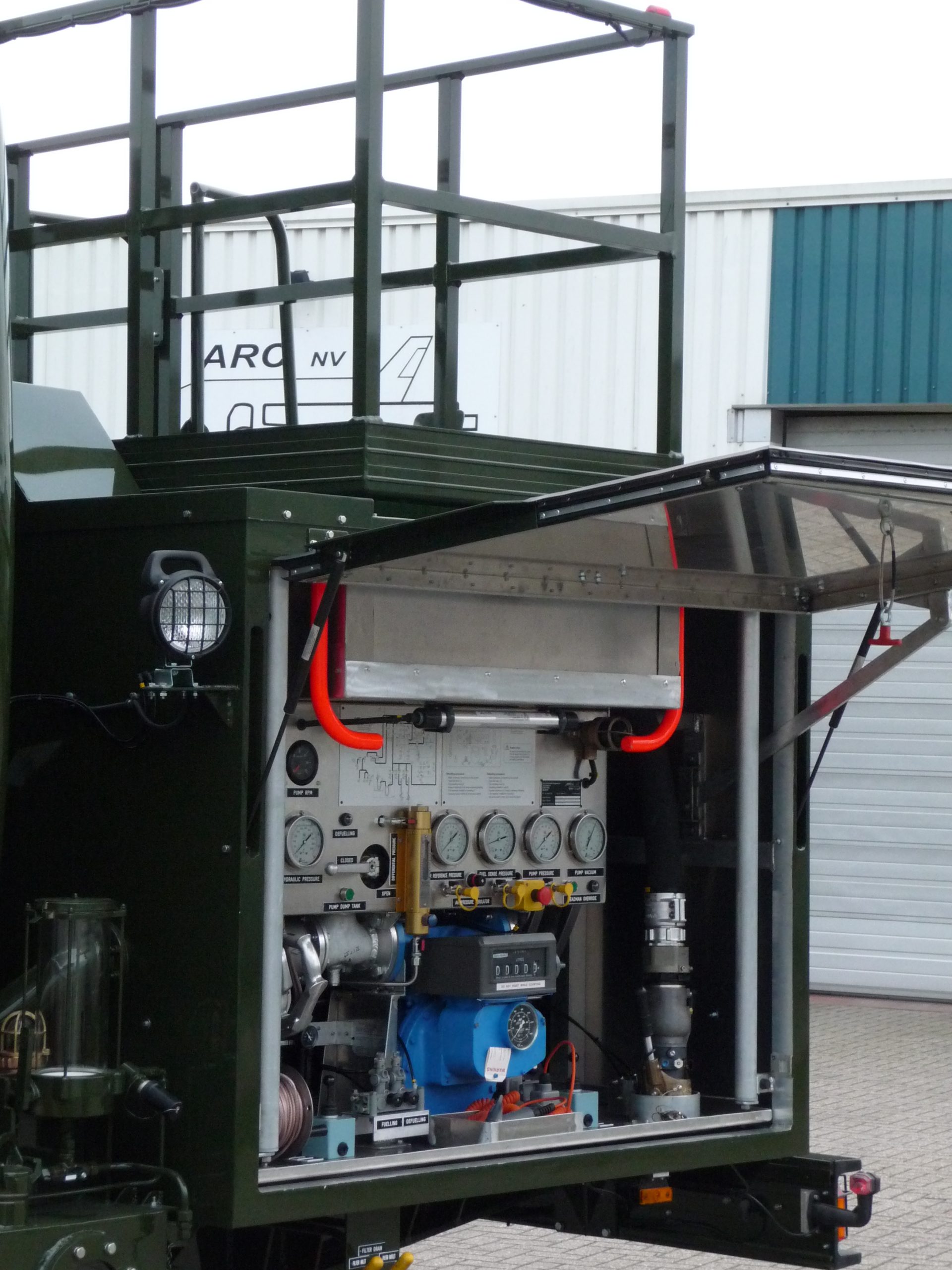
During underwing pressure fuelling, the operator is expected to record the filter dP and the corresponding flow rate shortly after fuelling begins, once the maximum flow rate for that fuelling has been reached.
The operator must be able to confirm that:
- the observed dP remains below the maximum allowed for the filter;
- there is no unexplained increase or decrease;
- the indication is consistent with previous fuellings at a similar flow rate;
- any abnormal variation is reported and investigated;
- the equipment remains serviceable throughout the operation.
The dP indication must therefore be visible and readable from the normal operating position.
If the gauge face is obscured, its lens is damaged, its scale cannot be read, its piston is sticking, or the electronic display is unreliable, the operator cannot properly complete the required monitoring.
This is not simply an inconvenience. It removes information needed to make an operational decision.
Maintaining serviceable equipment, reliable monitoring systems, and documented controls forms part of the broader framework discussed in ARC’s article on aviation refuelling standards.
Dirty, Obscured, and Damaged Gauges Are Not Always the Same
A useful distinction should be made between a gauge that is temporarily obscured and one that is damaged or unreliable.
For example, the external lens may be covered with dirt that can be safely removed during the inspection. If cleaning restores full visibility, the gauge is undamaged, the scale is legible, and the indication can be confirmed as normal, the original issue may have been resolved before release.
That is different from a gauge with:
- cracked or broken glass;
- internal condensation or contamination;
- an unreadable or damaged scale;
- a sticking piston or pointer;
- incorrect zeroing;
- delayed or laboured movement;
- physical impact damage;
- leaking or damaged sensing connections;
- an unreliable electronic display or signal.
Where damage remains, or there is uncertainty about the accuracy or response of the indication, the equipment should not be released based only on an operator’s visual judgement.
A maintenance assessment is required.
The Risk of a Sticking or Non-Zeroing Gauge
A gauge may appear to have only a minor indication problem while hiding a more serious functional defect.
For a piston-type dP gauge, the piston must move freely throughout its intended range and return correctly to zero when the relevant pressure difference is removed.
Laboured movement can delay the indication. Incorrect zeroing can produce a misleading reading. A compressed or damaged internal spring can also affect the gauge response.
Industry practice provides a practical example in which excessive dP was not identified because the gauge was sticking. The filter element was subsequently damaged and ruptured.
The lesson is clear: a gauge that does not respond correctly can conceal the condition it is intended to reveal.
Maintenance checks must therefore assess function, not only external appearance.
A dP Limiting Device Does Not Replace Operator Monitoring
Some filter vessels are equipped with a dP limiting device, such as a pressure switch connected to a piston gauge or an electronic dP monitoring system.
A dP limiting device provides an additional protective function. Where fitted, it can stop fuel flow when the maximum change-out dP is reached.
However, it does not replace the operator’s requirement to observe the dP indication and identify unexplained positive or negative changes.
A limiting device may protect against excessive positive dP, but it does not necessarily identify:
- an unexpected reduction in dP;
- element bypass;
- seal failure;
- an abnormal trend below its activation setting;
- a defective or delayed primary indication.
The presence of a dP limiting device is therefore not justification for continuing with an unreadable or unreliable dP indication.
Finding an Unreadable Differential Pressure Gauge During Pre-Use Inspection
The pre-use inspection is the point at which the operator confirms that the equipment is serviceable before it leaves the parking area or enters the aircraft stand.
Its purpose is to identify defects before the aircraft refueller or hydrant dispenser is connected to the aircraft and before fuel transfer begins.
When an unreadable differential pressure gauge is discovered during this inspection, the inspection has achieved its purpose. A condition that could prevent the required operational monitoring has been identified before live fuelling.
The wrong response would be to normalise the defect because:
- the equipment is needed for the next aircraft;
- no high dP was reported during the previous shift;
- the pump and meter remain operational;
- another operator believes the gauge is probably acceptable;
- the dP limiting device has not activated;
- the planned delivery is small;
- the flow rate can still be observed.
None of these points restores the required dP indication.
The equipment should remain unavailable until the condition has been assessed and the required monitoring capability has been restored, or an approved independent alternative has been formally confirmed as fully functional.
The importance of equipment readiness before fuel transfer is also reflected in ARC’s overview of aircraft ground refuelling procedures.
What to Do After Finding an Unreadable Differential Pressure Gauge
The exact response must follow the organisation’s approved procedures, the applicable operating standard, customer requirements, airport rules, and OEM instructions.
The controlled sequence should normally include the following actions.
-
Do Not Release the Equipment
The aircraft refueller or hydrant dispenser must not be released for pressure fuelling while its required dP indication is unavailable or unreliable.
-
Report the Defect
The operator should notify the responsible supervisor, maintenance function, or equipment-control point without delay.
The report should describe what was observed, including whether the issue involved physical damage, poor visibility, incorrect zeroing, sticking movement, leakage, an electronic fault, or another symptom.
-
Prevent Unintended Use
The equipment should be identified in accordance with the operator’s defect-control or unserviceability procedure to prevent another person from using it unintentionally.
-
Carry Out a Technical Assessment
The assessment should consider, as applicable:
- gauge condition and legibility;
- correct zeroing;
- free movement of the piston or pointer;
- correct gauge range and scale;
- sensing lines, valves, and connections;
- evidence of leakage, blockage, or contamination;
- electronic transducers, wiring, displays, or PLC signals;
- any associated dP limiting device;
- calibration or verification status;
- relevant maintenance and defect history.
-
Repair or Replace the Defective Component
The corrective action must restore the required monitoring function, not merely improve the gauge’s external appearance.
-
Functionally Verify the System
After repair or replacement, the dP indication should be checked in accordance with the approved maintenance procedure and manufacturer’s instructions.
Where a dP limiting device is installed, its activation and fuel-flow interruption functions must also be verified when required by the applicable maintenance procedure or following work that affects the system.
-
Record the Work and Release Decision
The defect, assessment, corrective action, functional test result, and return-to-service decision should be documented in the equipment records.
This follows the same defect-control principle discussed in ARC’s article on a small fuel leak found during an aircraft refueller inspection: defects identified before operation should be reported and controlled rather than normalised or carried into live aircraft fuelling.
Routine Testing of dP Gauges
A serviceable dP gauge must be maintained and tested throughout its operating life.
For piston-type dP gauges used in Jet A-1 service, the free-movement and correct-zeroing check is required every six months. For piston-type dP gauges used in Avgas service, the corresponding check is required monthly.
Where a dP limiting device is fitted, its function should be checked every six months to confirm that the fuelling operation stops when the activation pressure is reached. This check is normally completed at the same time as the piston-gauge free-movement check.
All routine tests should be recorded.
These scheduled checks do not reduce the importance of pre-use inspection or operational monitoring. A gauge can be within its formal inspection or test period and still become damaged, obstructed, or unreliable between scheduled checks.
Scheduled maintenance provides periodic assurance. The pre-use inspection confirms equipment condition before the next operation.
Both are necessary.
Corrected dP Cannot Compensate for an Unreliable Gauge
Differential pressure depends on flow rate. For this reason, some operations use corrected dP when direct comparison at a consistent high flow rate is not practical.
Corrected dP is an observed reading extrapolated to the dP that would be expected at the maximum achievable flow rate.
However, differential-pressure correction is technology-specific. It should only be applied using a conversion graph, table, calculator, or algorithm supplied or endorsed by the filter manufacturer.
For water barrier filters, dP correction is not applicable because there is no applicable correction algorithm for this filtration technology.
The preferred approach is to record dP at or close to the maximum achievable flow rate, or at the same sufficiently high flow rate each time. Correction should only be used when these direct-comparison methods are not practical and where it is applicable to the installed filtration technology.
Most importantly, corrected dP begins with a valid observed dP reading and a valid flow-rate measurement.
If the original dP indication is unreadable, sticking or otherwise unreliable, any corrected result derived from it will also be unreliable.
A calculation cannot restore the integrity of a defective instrument.
Corrected dP also does not replace real-time operational monitoring. The operator must still be able to identify an excessive or abnormal condition while fuel is being transferred.
What This Means for Operators and Supervisors
For the operator, the decision should be straightforward:
If the required dP indication cannot be read reliably, do not release the aircraft refueller or hydrant dispenser for pressure fuelling. Report the defect.
For the supervisor, the responsibility is to support that decision and ensure that the defect is controlled rather than informally managed.
Operators should not be pressured to continue because aircraft turnaround requirements are demanding or because alternative fuelling equipment is unavailable.
A strong reporting culture treats defects found during inspection as valuable information. It does not treat them as an operational inconvenience.
What This Means for Maintenance and Fleet Management
For maintenance personnel, the task is not limited to replacing a cracked lens or damaged gauge.
The complete indication system should be considered, including:
- the sensing arrangement;
- gauge response and zeroing;
- associated isolation valves;
- the dP limiting device;
- electronic signals and displays;
- any evidence that contamination or another system condition contributed to the failure.
Repeated gauge defects may indicate:
- excessive vibration;
- poor component location;
- inadequate mechanical protection;
- water or weather exposure;
- cleaning-related damage;
- ageing components;
- unsuitable maintenance intervals;
- blocked or contaminated sensing lines;
- recurring impact during operation or servicing.
For fleet and equipment managers, recurring dP gauge failures should be tracked as equipment-reliability data.
A pattern of defects may justify improved gauge protection, component standardisation, revised preventive-maintenance intervals, system refurbishment, or conversion to an approved electronic monitoring arrangement.
Early action protects filter-system integrity and supports equipment availability.
The Lesson From the Quiz
The correct answer is not based on the assumption that every visible gauge defect automatically means that the filter elements have failed.
It is based on a more precise operational principle:
The operator must have a valid and reliable filter differential-pressure indication to complete the required monitoring during pressure fuelling.
Where that indication is unavailable, and no approved independent alternative has been technically confirmed as fully functional, the equipment is not in the expected condition for the operation.
Continuing because fuel flow appears normal is not sufficient.
Monitoring flow rate instead is not an equivalent control.
Relying only on a dP limiting device is not sufficient.
The correct immediate action is to remove the equipment from service, report the defect, and restore or formally confirm the required monitoring function before the aircraft refueller or hydrant dispenser returns to pressure-fuelling operation.
Conclusion: Responding to an Unreadable Differential Pressure Gauge
An unreadable differential pressure gauge on an aircraft refueller or hydrant dispenser must be treated as an equipment serviceability defect.
The dP indication forms part of the system used to monitor filter performance during fuel flow. It allows the operator to verify that the pressure difference remains within the permitted limit and to identify unexpected increases or decreases that may require investigation.
Normal fuel flow does not prove that filter dP is acceptable.
A dP limiting device does not replace operator observation.
Corrected dP cannot be calculated reliably from an unreliable indication.
Where the required dP indication is damaged, unreadable, or unreliable, and no approved independent monitoring arrangement has been technically confirmed as fully functional, the required action is clear:
Do not release the equipment for pressure fuelling. Report the defect, assess the system, restore the function, verify correct operation, and record the return-to-service decision.
At ARC NV, inspection, maintenance, repair, refurbishment, spare-parts support, and lifecycle evaluation all contribute to keeping aircraft refuellers, hydrant dispensers, and other aviation fuelling equipment safe, reliable, and ready for operation.
Contact Us
If your operation is facing recurring dP gauge defects, filtration-monitoring issues, pressure-control problems, filter-vessel concerns, hydraulic faults, or increasing fuelling-equipment downtime, ARC NV can support with inspection, maintenance, repair, refurbishment, spare parts, and lifecycle evaluation.
Contact ARC NV to discuss how we can support the safe, reliable, and compliant operation of your aviation refuelling equipment throughout its lifecycle.
Email: question@arc-refuellers.be
Telephone: +32 3 844 55 68

 Repostadores
 Dispensadoras
 Aplicaciones Militares
 Repuestos
 Mantenimiento y reparaciones
 Restauración de vehículos
 Inspecciones
 Gestión del ciclo de vida del vehículo

