
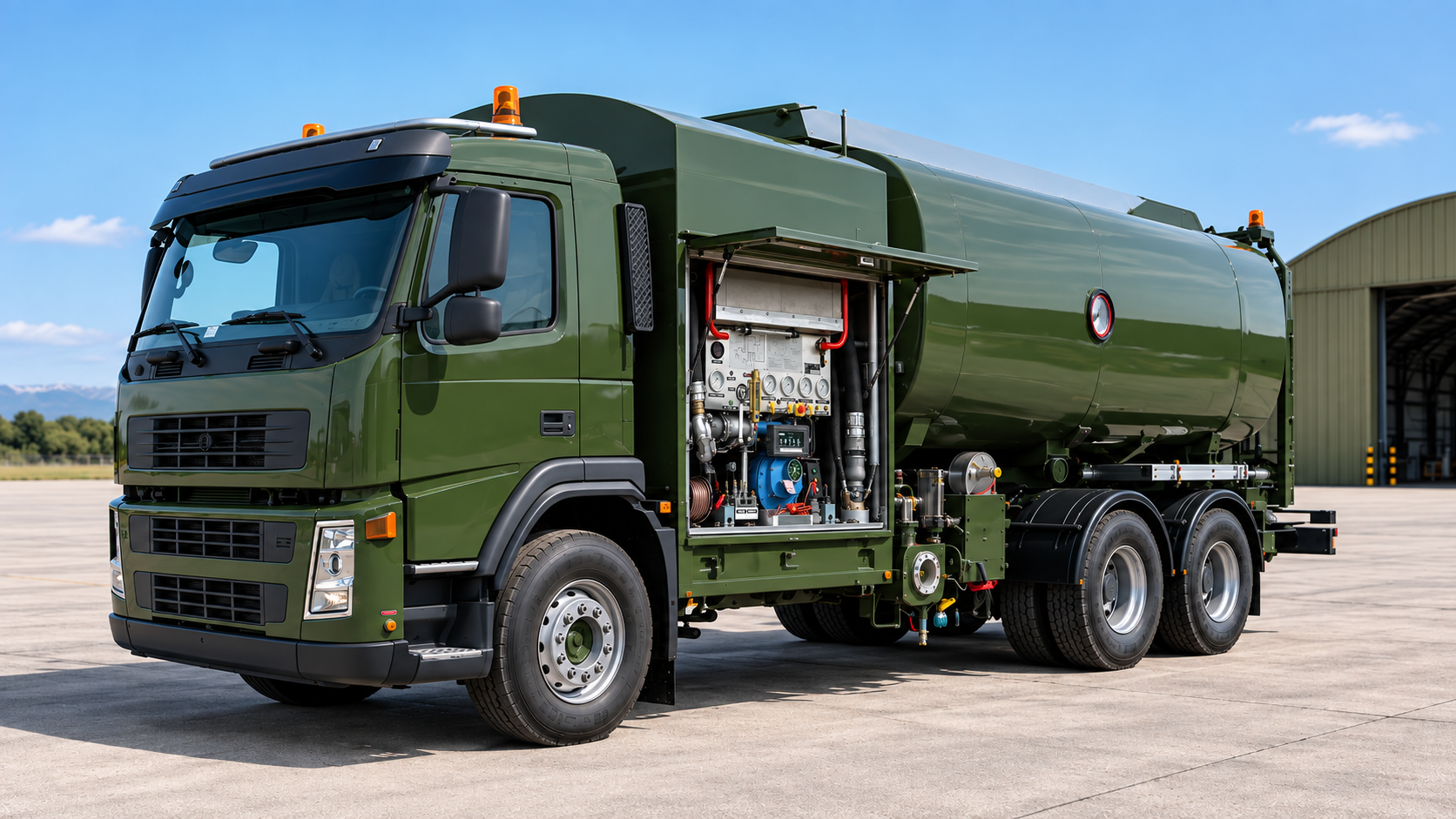
Military vs Civil Aircraft Refuellers: Key Engineering Differences

At first glance, military aircraft refuellers and civil aircraft refuellers may appear to be variations of the same machine. Both can combine a chassis, aviation fuel tank, pump, filtration, metering, pressure control, hoses, aircraft fuelling couplings, deadman control, bonding equipment and emergency systems.
That similarity can be misleading.
The fundamental difference is not the colour of the vehicle, the badge on the door or whether it has all-wheel drive. It is the engineering requirement behind the vehicle.
A civil aircraft refueller is normally specified around a defined airport environment, known aircraft population, established maintenance infrastructure and repeatable operating procedures. A military aircraft refueller may work under those same conditions at a permanent air base, but it may also be required to support dispersed operations, temporary infrastructure, different fuel specifications, different aircraft interfaces or a maintenance and logistics concept designed around long-term operational availability.
The result is an important procurement principle:
A military aircraft refueller should be designed from the mission backwards, not from a standard vehicle forwards.
ARC NV applies this total-vehicle engineering approach across its aircraft refueller designs and military applications.
1. The First Difference Is the Design Envelope
The most useful question at the beginning of a refueller project is not:
“Do we need a military or civil vehicle?”
It is:
“Under exactly what conditions must this vehicle remain safe, functional and supportable?”
For a civil airport, many elements of that environment are comparatively stable. The operating surfaces, aircraft stands, vehicle routes, maintenance facilities and normal aircraft population are usually known before the refueller is specified.
A defence requirement can introduce a wider envelope. The same vehicle may have to support normal air-base activity and still remain suitable for temporary deployment. Operating surfaces may differ. Workshop support may be limited. Crew equipment may influence cab access and control ergonomics. The required aircraft population may create several delivery configurations. Long-term spare-parts availability and configuration control may be procurement requirements rather than matters left to the operator after delivery.
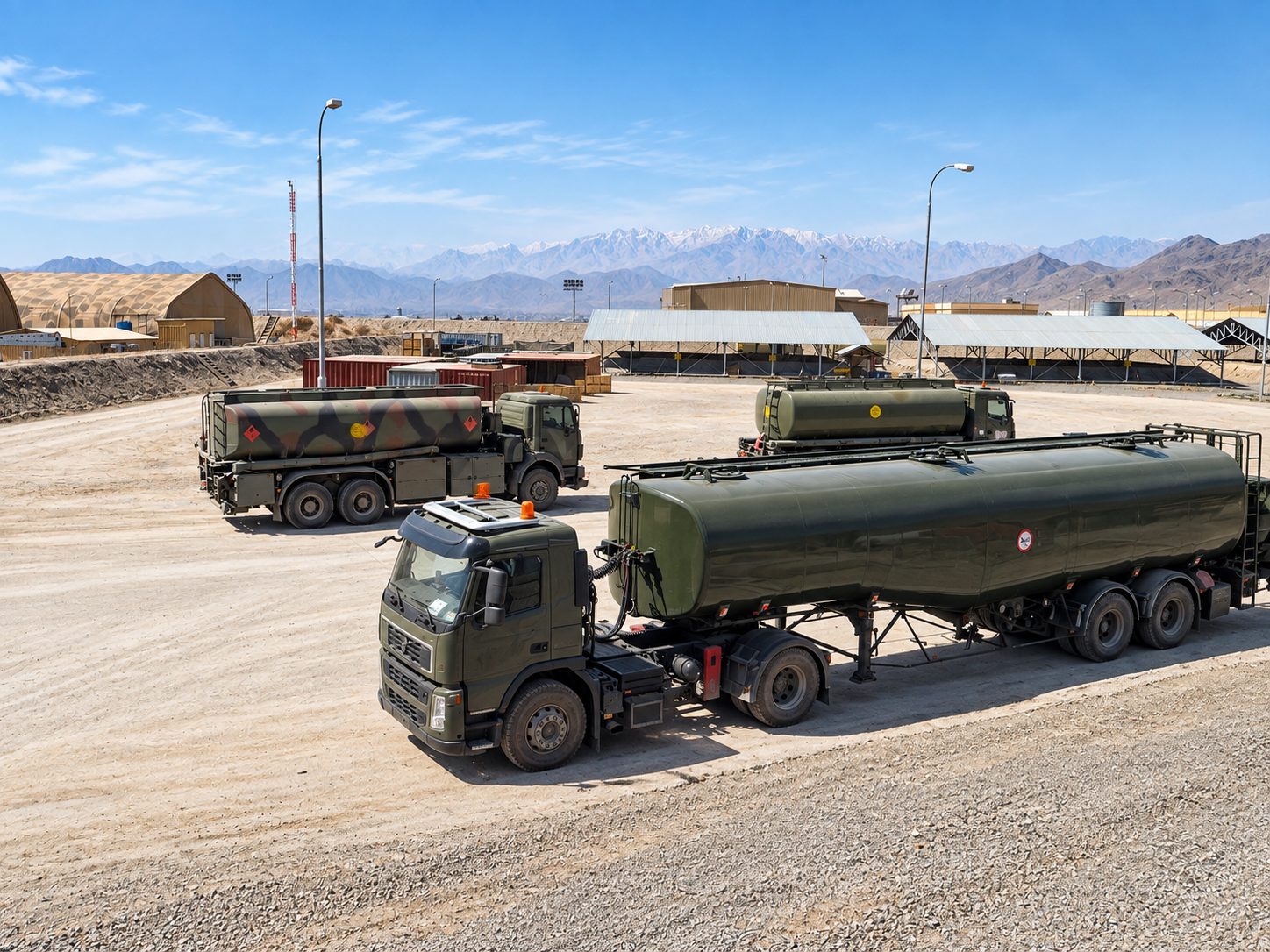
This is why no technically defensible rule says military = off-road.
Some military aircraft refuellers spend almost their entire operating life on prepared airfield surfaces. Others require mobility beyond normal airport pavements. The chassis and superstructure should therefore be selected against the defined terrain, payload, climate, transportability and duty-cycle requirements rather than against the word military.
2. Chassis Selection Becomes a System-Engineering Decision
For any aircraft refueller, chassis selection affects far more than vehicle movement.
Tank capacity and usable payload influence gross vehicle mass and axle loading. Tank position affects centre of gravity. The fuelling module introduces concentrated loads. Pumps, pipework, hose reels, platforms, cabinets, and auxiliary systems must be integrated without exceeding chassis limitations or compromising stability and maintainability.
EI 1540, 6th edition includes the design and construction of aircraft fuellers, hydrant dispensers and associated mobile equipment within its scope and treats the fuelling installation as an integrated engineering system rather than an unrelated chassis and fuel module.
For a defence vehicle, additional mobility requirements can change that architecture significantly.
Increased ground clearance, driven-axle configuration, suspension characteristics, tyre specification, approach and departure geometry, and equipment stowage may become design inputs. So can the effect of chassis torsion on the tank, subframe and product pipework.
This leads to an important engineering distinction:
Off-road capability is not a chassis option added at the end of the project. When it is required, it affects the structural integration of the complete refueller.
Consider flexible pipe connections, equipment restraint, tank mounting, cabinet construction, and component accessibility against the expected vehicle movement and vibration environment.
3. Military Aircraft Refuellers: Fuel Requirements Change More Than the Tank Label
Fuel specification is one of the clearest areas where a military requirement can directly alter the fuelling-system design.
Fuel Grade Must Be Specified Precisely
Current aviation-fuel specifications distinguish several relevant kerosene-type turbine fuels.
MIL-DTL-83133 covers JP-8 / NATO F-34 and NATO F-35, while MIL-DTL-5624 covers the high-flash-point JP-5 / NATO F-44.
Jet A-1 may also be specified under Def Stan 91-091, depending on the contractual and operational framework.
For the vehicle engineer, these designations cannot simply be grouped under “jet fuel”.
The required fuel grade and additive condition can influence filtration qualification, seals and other wetted materials, product identification, contamination-control philosophy, sampling arrangements and operating procedures.
A military refueller should therefore not automatically be described as multi-fuel capable.
If a procurement requires more than one fuel grade, engineering must establish how those products will be managed. Material compatibility alone is insufficient. Consider cross-contamination risk, residual product, filtration, identification, operating procedures, and any required segregation.
The same principle applies to additive injection. An onboard additive-injection system should exist because the procurement requirement demands it—not simply because the vehicle is labelled military.
Filtration Is a Particularly Important Difference
The current EI 1581, 7th edition, including subsequent addenda, makes the distinction especially clear.
EI 1581 identifies:
- Category C for commercial aviation fuel;
- Category M for military jet fuel;
- Category M100 for military jet fuel containing the applicable thermal-stability additive.
That means filter/water-separator selection is not simply a matter of choosing a vessel large enough for the design flow. The qualification category must match the intended fuel service.
For defence procurement, the fuel specification, additive condition and filtration requirement should therefore be established together.
That is a much stronger engineering requirement than simply writing “suitable for military aviation fuel” into a tender.
4. Aircraft Interfaces Can Drive the Complete Fuel System
The required aircraft population strongly influences refueller architecture.
Both civil and military aircraft refuellers may use established aircraft-side fuelling interfaces.
For pressure refuelling, this normally means a standard 2½-inch underwing pressure-refuelling nozzle connected to the aircraft pressure-fuelling adapter.
Current SAE AS5877C defines requirements for aircraft pressure-refuelling nozzles used for refuelling and defuelling aircraft equipped with pressure fuel-servicing systems. ISO 45:1990, reconfirmed in 2024, specifies the basic dimensions and access clearance for aircraft pressure-refuelling connections.
For overwing fuelling, a manually operated aviation overwing nozzle may be used where the aircraft requires gravity or overwing fuel delivery.
These interfaces are relevant to both civil and military aviation. Their application depends on the aircraft being served—not on whether the refueller itself is classified as civil or military.
A civil refueller serving a predictable commercial fleet may therefore be optimised primarily for pressure fuelling, while a defence specification supporting a broader aircraft population may require a combination of underwing and overwing delivery.
Defence and Interoperability-Specific Interfaces
A defence requirement can also extend beyond the normal aircraft-side interfaces.
Depending on the mission and fuel-support architecture, you may need additional connections to transfer fuel between vehicles, hose assemblies, temporary storage, mobile fuel systems, or other ground-fuelling equipment.
One example is the A-A-59377 sexless-type quick-disconnect coupling interface.
Mission-specific systems can use 2-inch or 3-inch unisex couplings, in valved or non-valved configurations, enabling compatible hose assemblies to connect without the conventional male/female relationship used by many other coupling systems.
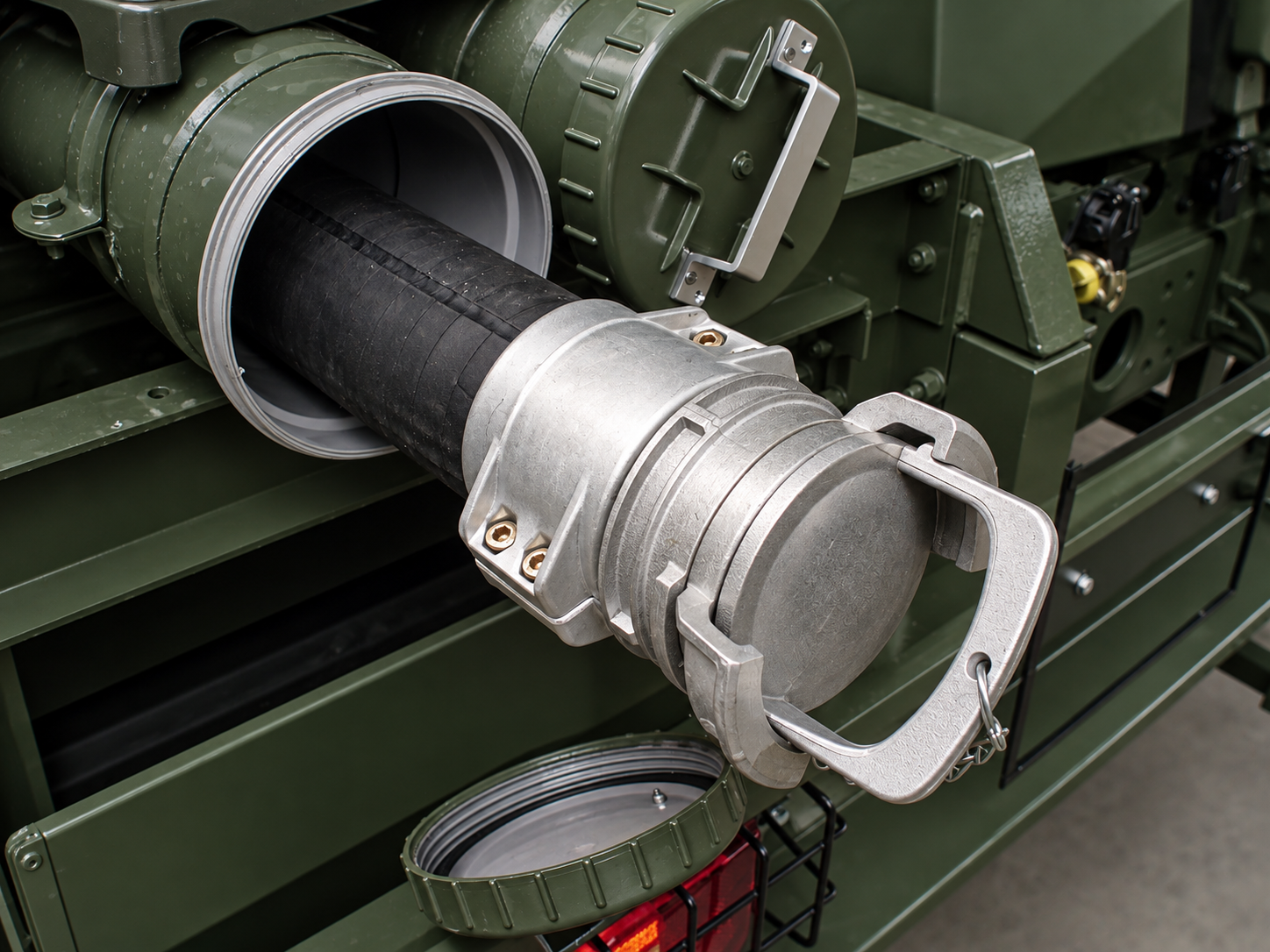
These should not be confused with the aircraft pressure-refuelling nozzle itself. They form part of the wider ground-fuel-transfer architecture where the operational requirement calls for them.
The important procurement point is therefore not to specify a particular coupling simply because the vehicle is military.
The interface requirement should be derived from the complete operational concept:
aircraft interfaces + ground-fuel-transfer interfaces + hose arrangement + required flow + operating pressure + filtration + pressure control + defuelling requirements.
Once those requirements change, the internal system changes with them.
Pump duty point, filtration capacity, meter range, pipe diameter, valves, hose arrangement, and control architecture must still function as one integrated system.
This is also why flow rate is not a valid military-versus-civil discriminator.
A large civil aircraft may require a substantially higher transfer rate than some military aircraft or helicopters. Conversely, a particular defence mission may require high-rate fuelling.
The refueller should therefore be engineered from a defined design-flow and pressure envelope, not from an assumed market category.
It is technically misleading to present civil and military aircraft refuellers as though they use fundamentally different safety philosophies.
They do not.
Both depend on the same core principle: fuel flow must remain controlled, the vehicle must remain safe around the aircraft, and foreseeable equipment or operator errors must not create an uncontrolled fuelling condition.
Typical safety-critical functions can include deadman control, primary and secondary pressure control, emergency shutdown, bonding, overfill protection, driveaway interlocks and equipment-stowage interlocks.
Differences appear when operating requirements change.
A defence programme may impose additional requirements for operator clothing, environmental exposure, remote support, component accessibility, or operation away from normal maintenance infrastructure.
But redundancy should never be invented merely because the vehicle is military.
A duplicated pneumatic/electronic function, alternative control mode, or additional protection should exist because it has been justified by the system requirement, hazard analysis, or contract—not because “military equipment should have a backup”.
That distinction matters most in safety-related control systems.
For more detail on one of the most important fuel-flow safeguards, see ARC’s article on Deadman Control in Aviation Refuelling.
6. A Military Vehicle Is Not Finished When the Hardware Is Finished
This is one of the biggest differences that is often missed in comparisons between civil and military aircraft refuellers.
For serious defence procurement, the deliverable is not merely a truck.
It is an operational capability that must remain supportable for its intended service life.
That changes the engineering process.
Maintenance requirements should influence component selection while the vehicle is still being designed. Access to pumps, filters, meters, control valves and test points matters. So does the ability to pressure-test hoses, verify gauges, inspect tanks, troubleshoot electrical systems and replace components without unnecessarily dismantling adjacent systems.
A technically sophisticated design can become a poor defence asset if routine maintenance requires specialist resources that will rarely be available at the operating location.
The procurement therefore needs to consider the entire support environment:
technical documentation, recommended spares, special tools, training, maintenance intervals, inspection requirements, component obsolescence, configuration control and repair capability.
ARC addresses the same through-life principles through its Vehicle Lifecycle Management approach, supported by maintenance and repairs and refuelling-equipment spare parts.
7. Configuration Control Is a Defence Capability, Not Administrative Overhead
An aircraft refueller can remain in service for many years.
During that period, the original meter may become obsolete. A pressure-control component may be superseded. Electrical hardware may change. The chassis OEM may discontinue a system. Operational experience may also lead to a safety modification.
If those changes are not controlled, identical-looking vehicles can gradually become technically different.
That creates problems for maintenance procedures, spare-parts holdings, fault diagnosis, training and future modification.
A robust defence programme should therefore maintain a controlled technical baseline covering the vehicle configuration, drawings, equipment list, software or PLC configuration where applicable, manuals and approved changes.
Engineering changes should be traceable.
Updated documentation should follow the physical modification.
Spare-parts information should reflect the actual installed configuration.
That sounds administrative until a fleet has been in service for fifteen years and technicians are attempting to determine which pressure-control valve, meter register, or interlock arrangement is installed on which vehicle.
At that point, configuration management becomes operational readiness.
8. Acceptance Testing Must Prove the Vehicle as a System
A weak specification may carefully define individual components but fail to define how the completed vehicle will be accepted.
A refueller is an integrated fuel-transfer system.
A pump can pass its factory test and still perform incorrectly once installed with the vehicle’s pipework, filter, meter and pressure-control equipment. An emergency stop can operate electrically but fail to create the required fuel-system response. A deadman control can function in isolation but may interact incorrectly with another control valve.
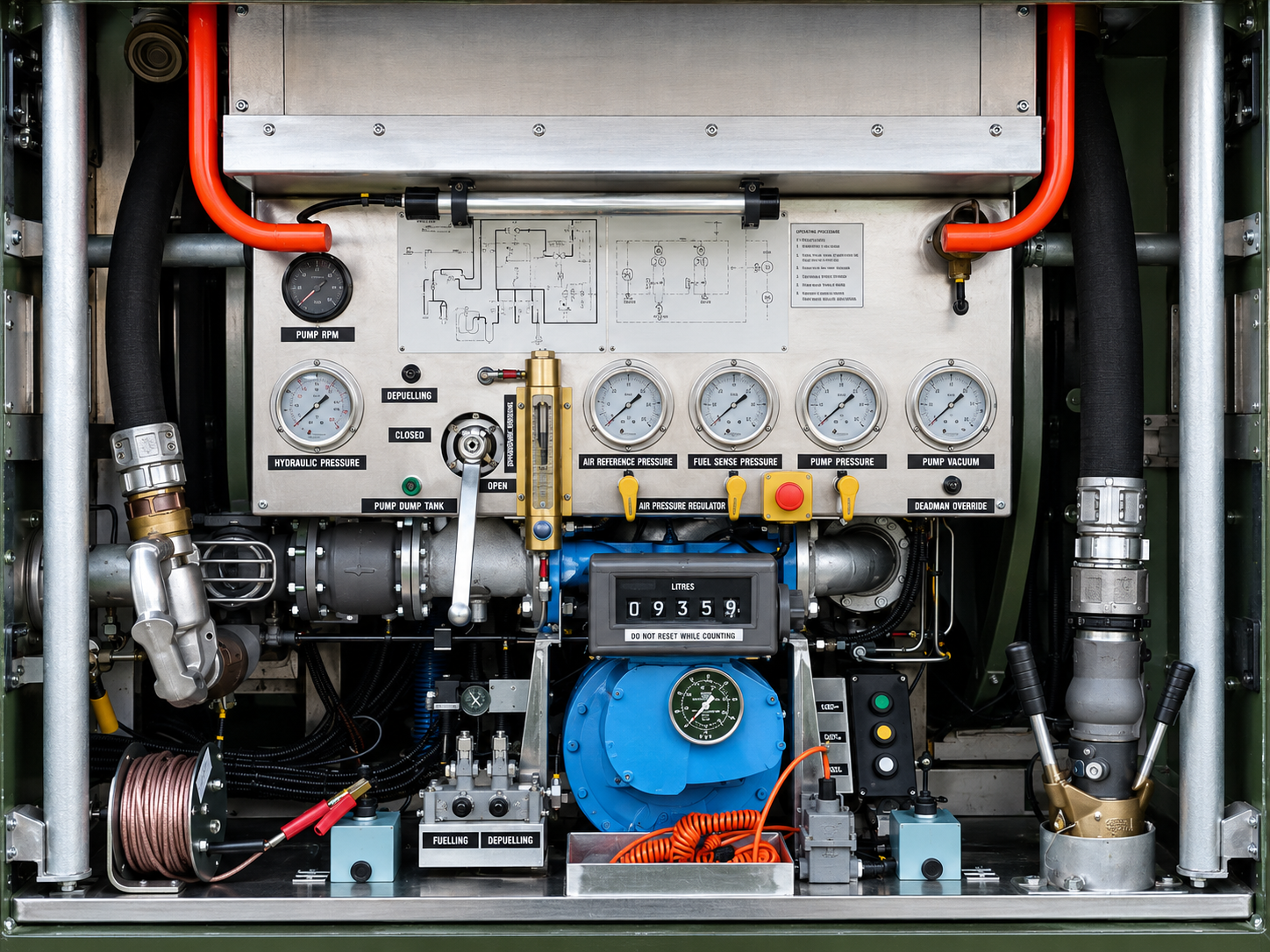
Acceptance testing therefore has to move from component verification to vehicle-level functional verification.
Depending on configuration, this may include fuel-system pressure and leak testing, pump-performance verification, meter proving or calibration, filter differential-pressure indication, pressure-control testing, hose testing, deadman response, emergency-stop operation, bonding continuity, overfill protection, equipment interlocks, hydraulic and pneumatic functions, and confirmation of correct equipment stowage.
Where required, Factory Acceptance Testing should establish that the completed vehicle conforms to the agreed technical specification before delivery.
Where contractually required, commissioning or Site Acceptance Testing should confirm the relevant vehicle functions under the receiving organisation’s operating conditions.
The same philosophy applies following major refurbishment. ARC’s guide to aircraft refueller refurbishment explains why testing, documentation and recommissioning form part of establishing a new technical baseline.
9. Civil and Military Requirements Should Be Mapped — Not Mixed Together
A defence aircraft refueller can sit at the intersection of several technical frameworks.
For aircraft-fuelling equipment, EI 1540 is an important industry engineering reference covering aircraft fuellers, hydrant dispensers and associated equipment. For defence applications, its applicability should be established alongside the applicable military, legal, aircraft-operator and contractual requirements.
For filtration, EI 1581 distinguishes between Category C, Category M and Category M100 applications, linking filter/water-separator qualification to the intended fuel service.
For aviation-fuel operations and quality assurance, JIG 1, JIG 2, JIG 4 and EI/JIG 1530 address different parts of the fuel supply and into-plane chain according to their respective applications.
For dangerous-goods road transport, ADR 2025 establishes requirements for carriage, tank and vehicle construction, equipment, operation, documentation, and training where ADR applies to the vehicle and operation.
Military procurement can then introduce further requirements through applicable Defence Standards, MIL specifications, NATO standardisation requirements, national legislation and the individual contract.
The engineering mistake is to write a specification stating simply:
“Vehicle shall be NATO compliant.”
That does not define a design requirement.
A proper compliance matrix identifies the applicable requirement, the system or subsystem to which it applies, the governing revision or contractual baseline, and the evidence required to demonstrate conformity.
ARC provides a wider overview of these interfaces in its guide to aviation refuelling standards.
Military vs Civil Aircraft Refuellers: Where the Engineering Actually Changes
| Engineering question | Civil aircraft refueller | Defence aircraft refueller |
|---|---|---|
| Mission profile | Usually based on defined airport operations | May include permanent-base, dispersed or deployed operating requirements |
| Mobility | Optimised primarily for airside and road operation | Additional mobility capability may be required by the mission |
| Chassis integration | Payload, axle loading, stability and manoeuvrability remain primary | Same fundamentals, potentially across a wider terrain and structural operating envelope |
| Fuel specification | Defined by the approved civil fuel grade and operating environment | May require specific military fuel grades or additive conditions |
| Filtration | Filter/water-separator qualification selected for the applicable fuel service | Category M or M100 filter/water-separator qualification may be required depending on fuel service |
| Aircraft interface | Configured around the airport’s aircraft mix | May require broader underwing, overwing, defuelling or interoperability interfaces |
| Flow rate | Defined by aircraft and operational demand | Also defined by aircraft and mission—not inherently higher |
| Safety systems | Deadman, pressure control, bonding, interlocks and emergency functions as applicable | Same fundamentals, with additional contract-specific requirements where justified |
| Maintenance | Often supported by established airport/OEM infrastructure | Supportability may have to extend to remote or deployed maintenance conditions |
| Configuration management | Important for fleet integrity | Can become a formal through-life system requirement |
| Spares and training | Operational support requirement | Frequently engineered as part of the complete capability |
| Acceptance | Functional testing and commissioning | May require a more formal compliance, FAT/SAT and documentation framework |
The distinction is therefore not a catalogue of military accessories.
It is the breadth and depth of the requirement against which the complete refueller must be engineered and supported.
10. The Procurement Question Should Be: “What Must This Vehicle Still Be Able to Do in Year 15?”
Tank capacity and nominal flow rate are easy to compare in a tender.
They are not enough to define a successful aircraft refueller.
A technically mature procurement should consider the vehicle’s future operating environment before its architecture is frozen: aircraft population, fuel specifications, duty cycle, operating surfaces, climate, delivery and defuelling functions, pressure envelope, maintenance strategy, crew interface, spare-parts concept, inspection programme, technical documentation, configuration control and acceptance philosophy.
This is particularly important in defence.
The lowest-risk vehicle is not necessarily the one with the most functions. Additional capability also creates additional components, interfaces, maintenance requirements, and failure modes.
The correct objective is therefore mission adequacy with controlled complexity.
Specify what the operation requires.
Engineer the vehicle against that requirement.
Verify the completed system.
Then support the configuration throughout its service life.
Conclusion: Military Refuellers Are Defined by Their Requirement, Not Their Appearance
Civil and military aircraft refuellers share many core technologies.
Both must transfer aviation fuel safely. Both depend on filtration, pressure control, fuel-quality protection, reliable hoses and interfaces, accurate metering where required, effective safety systems and competent maintenance.
The difference emerges from the mission surrounding those functions.
A defence requirement may extend the vehicle’s mobility envelope, specify different aviation fuels, require several aircraft delivery interfaces, demand a different maintenance concept or place greater emphasis on configuration management, training, spares and through-life support.
None of those features should be assumed.
They should be engineered from documented operational requirements.
That is the central difference between specifying a vehicle and specifying a defence aircraft-refuelling capability.
Contact Us
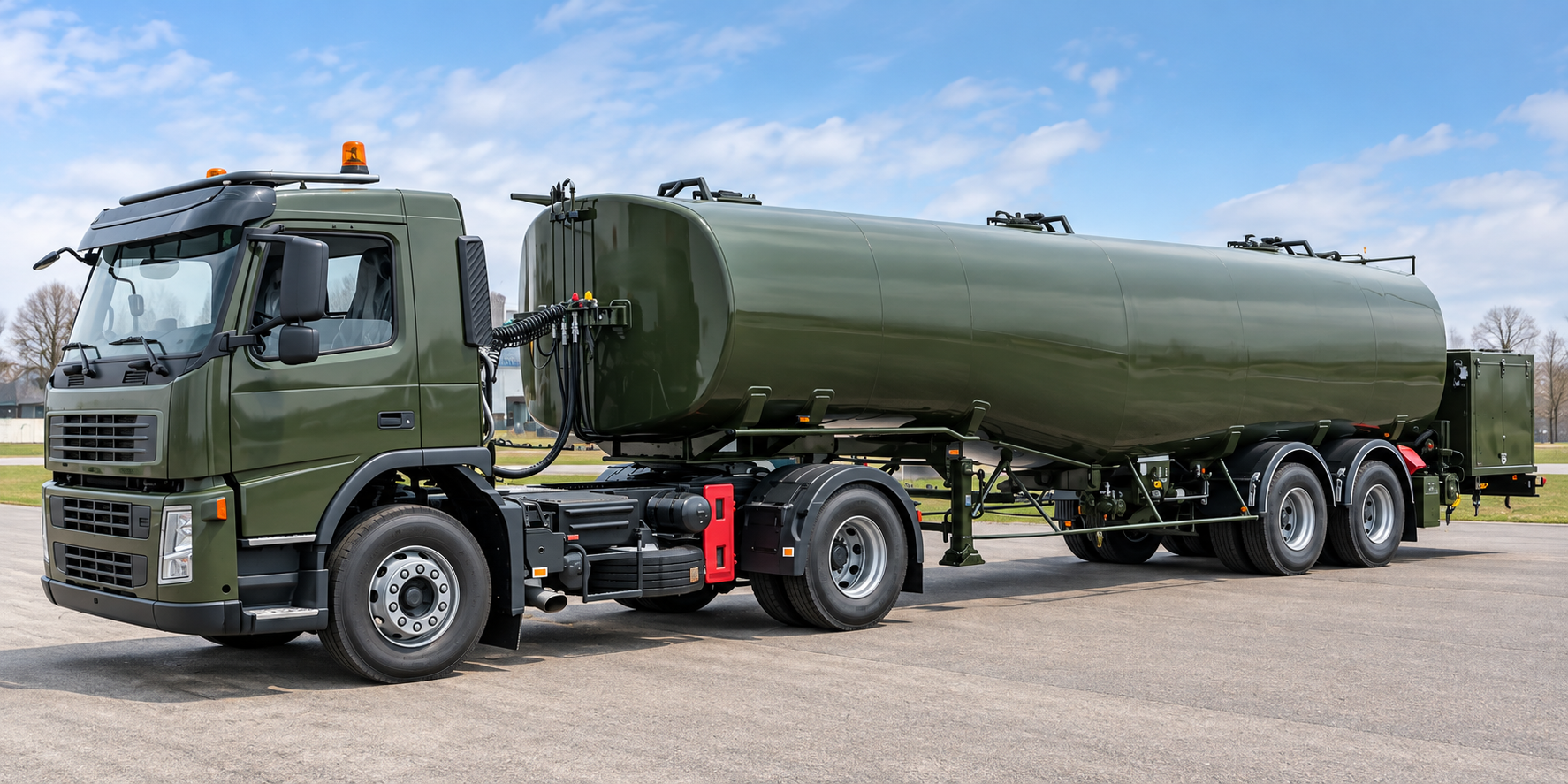
Whether you are specifying a new aircraft refueller, reviewing an existing fleet, planning a refurbishment or defining a long-term support strategy, ARC NV can support the project from initial requirement definition through engineering, construction, testing, documentation and lifecycle support.
ARC designs and constructs rigid and articulated aircraft refuellers for civil and defence aviation applications, with each configuration developed around the required aircraft, fuel specification, delivery flow, fuelling interfaces, mobility, safety systems and operational support requirements.
For more information, visit our Aircraft Refuellers and Military Applications pages.
To discuss a new-build, replacement, refurbishment or fleet-support requirement, contact ARC NV.
Email: question@arc-refuellers.be
Tel: +32 3 844 55 68

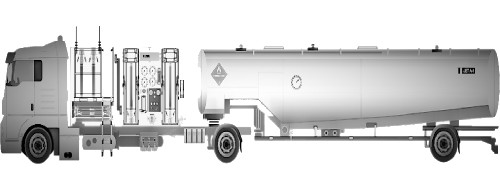 Ravitailleurs
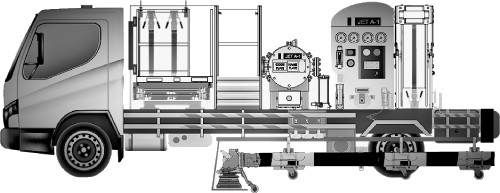 Distributeurs
 Applications Militaires
 Pièces de rechange
 Entretien et réparations
 Remise à neuf de véhicules
 Contrôles
 Gestion du cycle de vie des véhicules

